Canada's Great War Album by Canada's National History Society
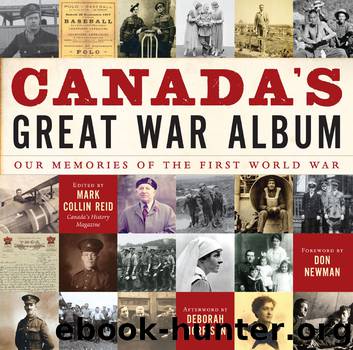
Author:Canada's National History Society [Reid, Mark Collin; Newman, Don; Morrison, Deborah]
Language: eng
Format: epub
ISBN: 9781443420174
Publisher: HarperCollins Canada
Published: 2014-03-14T16:00:00+00:00
A woman in Toronto sells flowers during the first “Alexandra Rose Day” in Canada, circa 1915. The charity drive raised money for local hospitals.
Facing page: Patriotic posters urged Canadians to contribute to the war effort.
The government’s promotion of “dilution” was shaped by pragmatism and cost consciousness, though there was some concern about the morals of the “common” factory girl. The IMB’s solution was to appoint two respectable female welfare supervisors, deemed of “good pedigree,” to supervise the new female workforce. The board was less concerned about health and safety than it was about the possibility that women’s sexual immorality would be unleashed in rough masculine workplaces.
Protection, as working-class women found, could become a form of surveillance. The supervision taking place on the factory floor paralleled new wartime laws to control prostitution and venereal disease and to address war-induced fears of family breakdown and youth delinquency. Whether through their naïveté or licentiousness, working-class women were perceived to be in danger of loosening the moral fibre of the nation. Blanche Read Johnston, a prominent leader in the Woman’s Christian Temperance Union, worried that factory women would become “careless and reckless” about their virtue, losing their respect for “the sanctity of marriage.”
The federal government and labour unions often labelled women’s work in munitions as “diluted” labour, suggesting that skilled craft occupations were being watered down. In reality, most women flooding into munitions were simply replacing unskilled male labourers.
By war’s end, a small number of women had tasted non-traditional work: they had operated elevators, milled tools, or worked as streetcar conductors. A more significant number took over for men in clerical occupations, such as banking, where wartime labour shortages accelerated an ongoing trend toward the feminization of white-collar work. But most women remained in traditional female jobs where substantial differentials existed between women’s and men’s pay rates.
There was little or no change in textile and garment factories, where many women laboured long hours for lower pay. Toronto’s Laura Hughes, the young, idealistic niece of Sam Hughes, the minister of militia and defence, was a rebel socialist in a family of war supporters; she went undercover as a worker at a knitting mill that supplied government war contracts. She then wrote a report for a local labour paper, criticizing, with considerable sympathy for the workers, the factory’s bad ventilation, crowded rooms, and poor pay for piecework. Owners accrued profits by “taking it out of the hides of their working men and women and working girls by reducing their wages and in some instances increasing their hours of labour,” she wrote.
Women workers proved to be less malleable than the government had predicted. Ignoring pleas not to interrupt war production, female munitions inspectors in Hamilton, Ontario, walked off the job in 1917. They were aggrieved about proposed wage reductions for incoming workers. The same year, a group of women factory workers approached The Toronto Star to publicize their grievances. “They are killing us off as fast as they are killing men at the trenches,” the deputation of six women protested.
Download
This site does not store any files on its server. We only index and link to content provided by other sites. Please contact the content providers to delete copyright contents if any and email us, we'll remove relevant links or contents immediately.
| Africa | Americas |
| Arctic & Antarctica | Asia |
| Australia & Oceania | Europe |
| Middle East | Russia |
| United States | World |
| Ancient Civilizations | Military |
| Historical Study & Educational Resources |
Cat's cradle by Kurt Vonnegut(15351)
Pimp by Iceberg Slim(14506)
4 3 2 1: A Novel by Paul Auster(12391)
Underground: A Human History of the Worlds Beneath Our Feet by Will Hunt(12097)
The Radium Girls by Kate Moore(12026)
Wiseguy by Nicholas Pileggi(5782)
The Fire Next Time by James Baldwin(5441)
Perfect Rhythm by Jae(5402)
American History Stories, Volume III (Yesterday's Classics) by Pratt Mara L(5307)
Paper Towns by Green John(5188)
Pale Blue Dot by Carl Sagan(5007)
A Higher Loyalty: Truth, Lies, and Leadership by James Comey(4959)
The Mayflower and the Pilgrims' New World by Nathaniel Philbrick(4502)
The Doomsday Machine by Daniel Ellsberg(4489)
Killers of the Flower Moon: The Osage Murders and the Birth of the FBI by David Grann(4447)
The Sympathizer by Viet Thanh Nguyen(4390)
Too Much and Not the Mood by Durga Chew-Bose(4346)
The Borden Murders by Sarah Miller(4324)
Sticky Fingers by Joe Hagan(4197)
